Webhooks enable real-time communication between AI Sync and external systems by sending HTTP POST requests when specific events occur in your system.
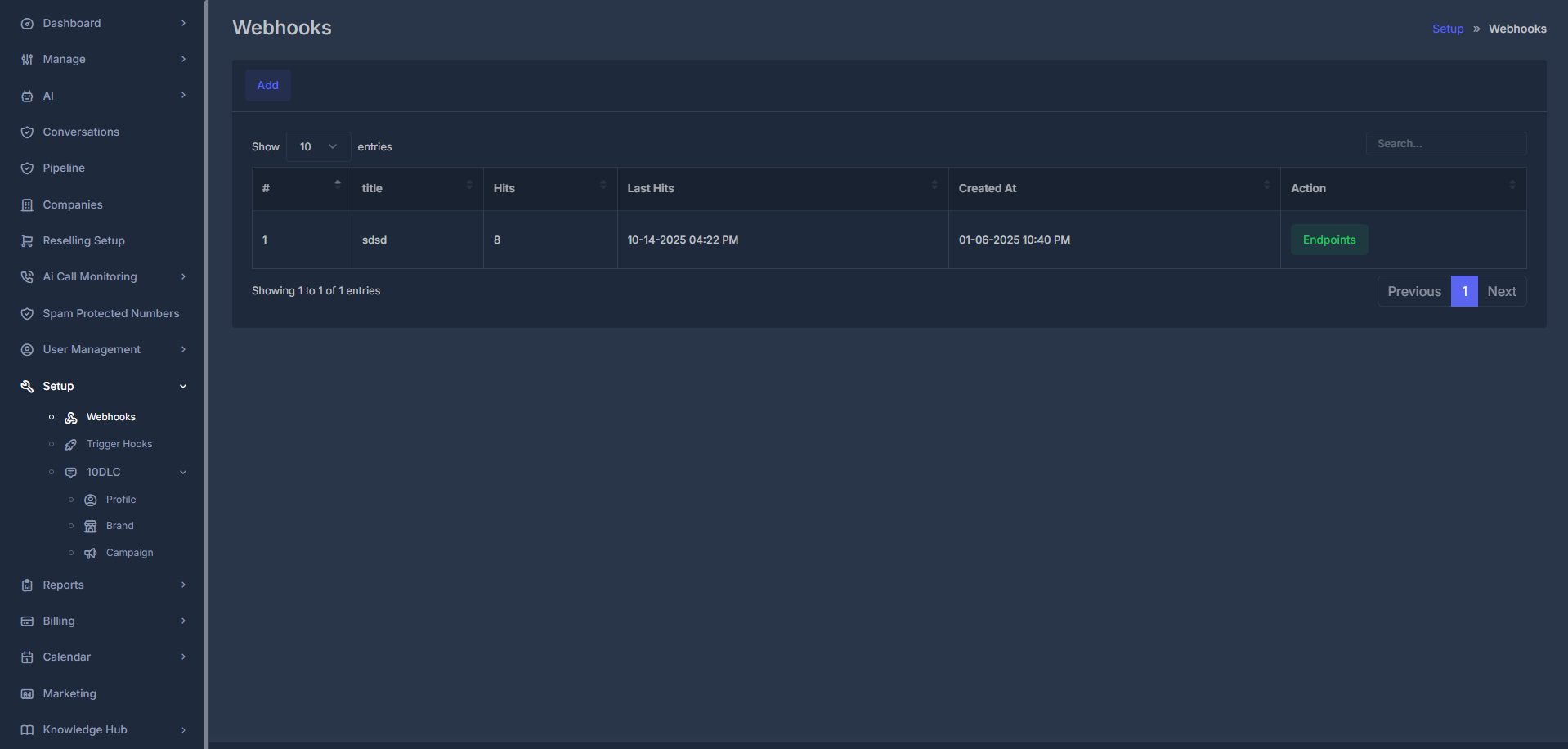
Navigate to Setup > Webhooks to manage your webhook configurations.
📊 Webhook Table Overview#
| Column | Description | Example |
|---|---|---|
| # | Sequential webhook ID | 1, 2, 3 |
| Title | Webhook name/identifier | CRM Integration, Analytics Sync |
| Hits | Total number of webhook calls | 1,247 |
| Last Hit | Most recent webhook execution | 2025-01-15 14:30:25 |
| Created At | Webhook creation timestamp | 2025-01-10 10:40 PM |
| Action | Management options | Edit, Delete, View Endpoints |
⚡ Quick Actions#
Add New Webhook
Create new webhook endpoints for your integrations
View Endpoints
Monitor webhook performance and delivery status
👁️ Viewing Webhook Details#
When you click a webhook entry in the table, you'll see a detailed view showing all of its configuration and delivery parameters.
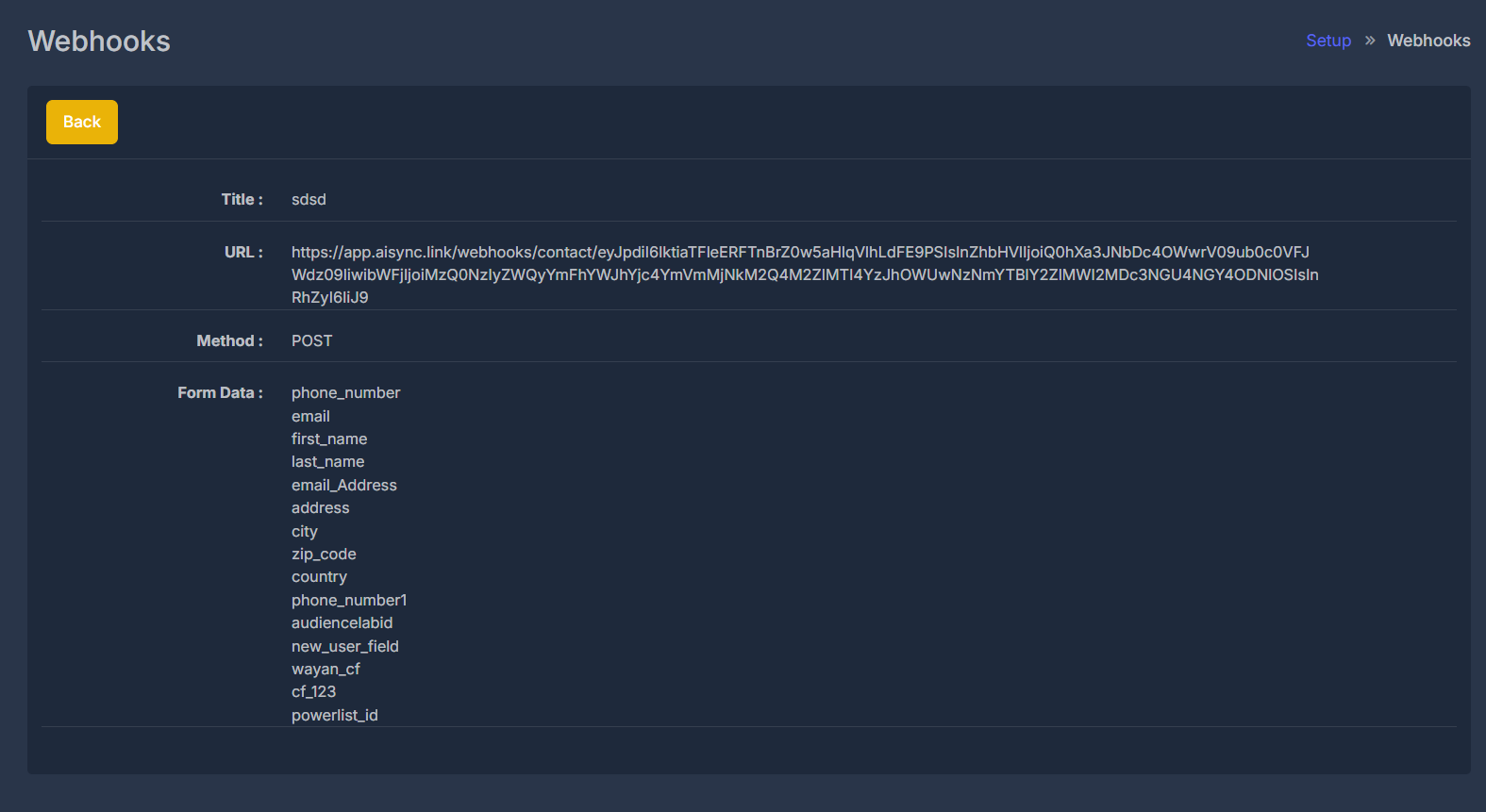
This detail page includes:
- Title: The name of the webhook for easy identification.
- URL: The full endpoint address where HTTP POST requests are sent.
- Method: The HTTP method used (always
POST). - Form Data:
A complete list of fields included in the payload sent to your endpoint.
Examples:phone_number,email,first_name,last_name,address,city,country,new_user_field,powelist_id,wayan_cf, and more....
This view allows you to:
- Verify the endpoint URL and method used
- See exactly which form fields are transmitted to your external system
- Easily copy field names for integration into your endpoints
Click the yellow Back button at the top to return to the main Webhooks overview table.
Use this page whenever you need to audit, troubleshoot, or integrate with your webhooks more precisely.
🔄 Webhook Workflow#
Event Occurs
An action happens in AI Sync (call ends, agent responds, etc.)
Webhook Triggered
System identifies configured webhooks for the event type
HTTP Request Sent
POST request with event data sent to your endpoint URL
Response Processed
Your system processes the data and sends acknowledgment
Retry Logic
Failed requests are retried with exponential backoff
🎛️ Webhook Configuration#
Creating a New Webhook
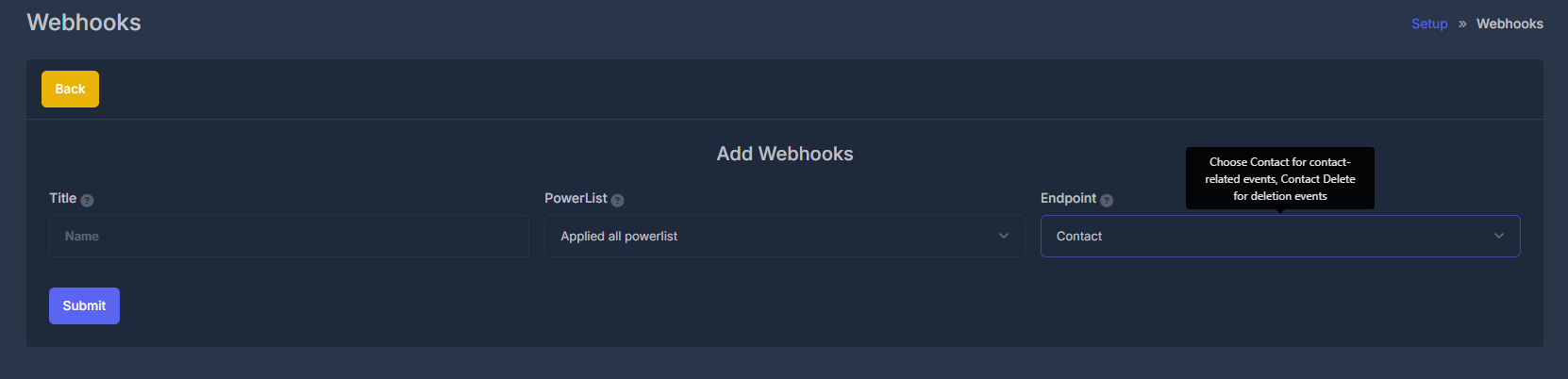
How to Add a Webhook:
-
Go to Setup > Webhooks
Click the yellow Add button to open the Add Webhook form. -
Fill out Webhook Details:
-
Title:
Enter a clear, descriptive name for your webhook.
Example:Home -
Powelist:
Select the appropriate option from the Powelist dropdown. This field lets you choose a predefined set or type related to your webhook logic. -
Endpoint:
Use the dropdown menu to select the desired endpoint or event trigger for your webhook.
Example:Contact,Contact Delete
Tip: You can select a single or multiple event types as needed for your integration.
After filling in all fields, click the purple Submit button to complete adding the webhook.
-
Tip: Hover over the event field to see additional info for each webhook trigger.
🎪 Available Webhook Events#
📞 Call Events#
Call Started
Event: call.started
Triggered: When a call begins
Use Cases: Call logging, real-time monitoring
Call Ended
Event: call.ended
Triggered: When a call completes
Use Cases: Call analytics, CRM updates
Call Answered
Event: call.answered
Triggered: When a call is answered
Use Cases: Connection tracking, response rates
Call Transferred
Event: call.transferred
Triggered: When a call is transferred
Use Cases: Transfer logging, agent routing
🤖 Agent Events#
Agent Created
Event: agent.created
Triggered: When a new AI agent is created
Use Cases: Inventory management, provisioning
Agent Updated
Event: agent.updated
Triggered: When agent configuration changes
Use Cases: Configuration sync, audit trails
Agent Status Changed
Event: agent.status_changed
Triggered: When agent goes online/offline
Use Cases: Availability tracking, monitoring
Agent Performance
Event: agent.performance
Triggered: Performance threshold events
Use Cases: Quality monitoring, alerts
📊 Campaign Events#
Campaign Started
Event: campaign.started
Triggered: When a campaign begins
Use Cases: Campaign tracking, notifications
Campaign Completed
Event: campaign.completed
Triggered: When a campaign finishes
Use Cases: Results processing, reporting
Lead Generated
Event: lead.generated
Triggered: When a new lead is created
Use Cases: CRM integration, lead routing
Appointment Scheduled
Event: appointment.scheduled
Triggered: When an appointment is booked
Use Cases: Calendar sync, confirmations
💬 SMS Events#
SMS Sent
Event: sms.sent
Triggered: When an SMS is delivered
Use Cases: Delivery tracking, billing
SMS Received
Event: sms.received
Triggered: When an SMS is received
Use Cases: Response handling, conversations
SMS Failed
Event: sms.failed
Triggered: When SMS delivery fails
Use Cases: Error handling, retry logic
SMS Replied
Event: sms.replied
Triggered: When recipient replies to SMS
Use Cases: Conversation tracking, engagement
📦 Webhook Payload Structure#
Standard Payload Format
All webhooks follow a consistent JSON structure:
{
  "event": "call.ended",
  "timestamp": "2025-01-15T14:30:25.123Z",
  "webhook_id": "wh_123456789",
  "data": {
    // Event-specific data
  },
  "metadata": {
    "version": "1.0",
    "signature": "sha256=abc123..."
  }
}
Call Event Payload Example
{
  "event": "call.ended",
  "timestamp": "2025-01-15T14:30:25.123Z",
  "webhook_id": "wh_123456789",
  "data": {
    "call_id": "call_987654321",
    "agent_id": "agent_abc123",
    "caller_number": "+1234567890",
    "called_number": "+0987654321",
    "call_duration": 180,
    "call_status": "completed",
    "call_direction": "outbound",
    "recording_url": "https://recordings.ai-sync.com/call_987654321.mp3",
    "transcription": "Hello, this is John calling about...",
    "sentiment": "positive",
    "disposition": "interested",
    "tags": ["qualified", "follow-up"],
    "custom_fields": {
      "lead_score": 85,
      "next_action": "schedule_demo"
    }
  },
  "metadata": {
    "version": "1.0",
    "signature": "sha256=abc123def456..."
  }
}
🔒 Security Best Practices#
Webhook Verification
Signature Verification
Always verify webhook signatures to ensure authenticity:
const crypto = require('crypto');

function verifyWebhookSignature(payload, signature, secret) {
  const expectedSignature = crypto
    .createHmac('sha256', secret)
    .update(payload)
    .digest('hex');

  return crypto.timingSafeEqual(
    Buffer.from(signature, 'hex'),
    Buffer.from(expectedSignature, 'hex')
  );
}

// Middleware to verify webhooks
app.use('/webhook/*', (req, res, next) => {
  const signature = req.headers['x-webhook-signature'];
  const payload = JSON.stringify(req.body);

  if (!verifyWebhookSignature(payload, signature, WEBHOOK_SECRET)) {
    return res.status(401).json({ error: 'Invalid signature' });
  }

  next();
});
Rate Limiting
Implement rate limiting to prevent abuse:
const rateLimit = require('express-rate-limit');

const webhookLimiter = rateLimit({
  windowMs: 15 * 60 * 1000, // 15 minutes
  max: 1000, // Limit each IP to 1000 requests per windowMs
  message: 'Too many webhook requests'
});

app.use('/webhook', webhookLimiter);
HTTPS Only
Always use HTTPS endpoints for webhook URLs:
// ✅ Correct - HTTPS endpoint
const webhookUrl = 'https://api.yoursite.com/webhook/ai-sync';

// ❌ Incorrect - HTTP endpoint (insecure)
const webhookUrl = 'http://api.yoursite.com/webhook/ai-sync';
Error Handling
Retry Logic
AI Sync implements exponential backoff for failed webhooks:
- Attempt 1: Immediate
- Attempt 2: 30 seconds delay
- Attempt 3: 2 minutes delay
- Attempt 4: 8 minutes delay
- Attempt 5: 32 minutes delay
- Final: Webhook marked as failed after 5 attempts
Response Codes
Return appropriate HTTP status codes:
app.post('/webhook', (req, res) => {
  try {
    // Process webhook data
    processWebhookData(req.body);

    // Success response
    res.status(200).json({
      received: true,
      timestamp: new Date().toISOString()
    });
  } catch (error) {
    // Log error for debugging
    console.error('Webhook processing error:', error);

    // Return error status
    res.status(500).json({
      error: 'Internal processing error',
      message: error.message
    });
  }
});
📊 Monitoring & Debugging#
Webhook Logs
Monitor webhook delivery and performance:
Delivery Status
- Success/failure rates
- Response times
- Error codes and messages
- Retry attempts
Performance Metrics
- Average response time
- Peak load handling
- Throughput statistics
- Error rate trends
Testing Webhooks
Test Endpoint
Use tools like ngrok for local testing:
# Install ngrok
npm install -g ngrok

# Start your local server
node webhook-server.js

# Expose local server
ngrok http 3000

# Use the HTTPS URL for webhook configuration
# https://abc123.ngrok.io/webhook
Mock Payloads
Test with sample webhook payloads:
curl -X POST https://your-webhook-url.com/webhook \
  -H "Content-Type: application/json" \
  -H "X-Webhook-Signature: sha256=test-signature" \
  -d '{
    "event": "call.ended",
    "timestamp": "2025-01-15T14:30:25.123Z",
    "data": {
      "call_id": "test_call_123",
      "call_duration": 120,
      "sentiment": "positive"
    }
  }'